

Materials Science · Updated May 2026
Two fibers dominate modern motorcycle slide protection: Kevlar® (an aramid first used in body armor in the 1960s) and UHMWPE (a polyethylene fiber developed in the 1970s that's now the highest-rated abrasion material in commercial use). They protect against the same thing — asphalt — but through completely different mechanisms. Below: the chemistry, the CE garment ratings each fiber unlocks, and which to actually wear for which kind of riding.
Jump to:
Quick answer (what to buy) Common questions What Kevlar is What UHMWPE is Head-to-head CE garment ratings Which to pick
Quick answer · skip the deep dive
UHMWPE wins on slide protection (and pulls modern motorcycle gear into CE Class AAA). Kevlar® wins on heat and price. Most premium gear blends both.
UHMWPE · Highest-rated abrasion fiber
Pando Moto Shell UH 03 Armored Base Layer
The Shell UH 03 uses Pando Moto's Balistex® UHMWPE fabric in the high-abrasion zones to hit CE Class AA under EN 17092 — a class most "armored" base layers don't reach. Wears invisibly under any jacket or hoodie. Includes Level 1 EN 1621-1 shoulder + elbow inserts.
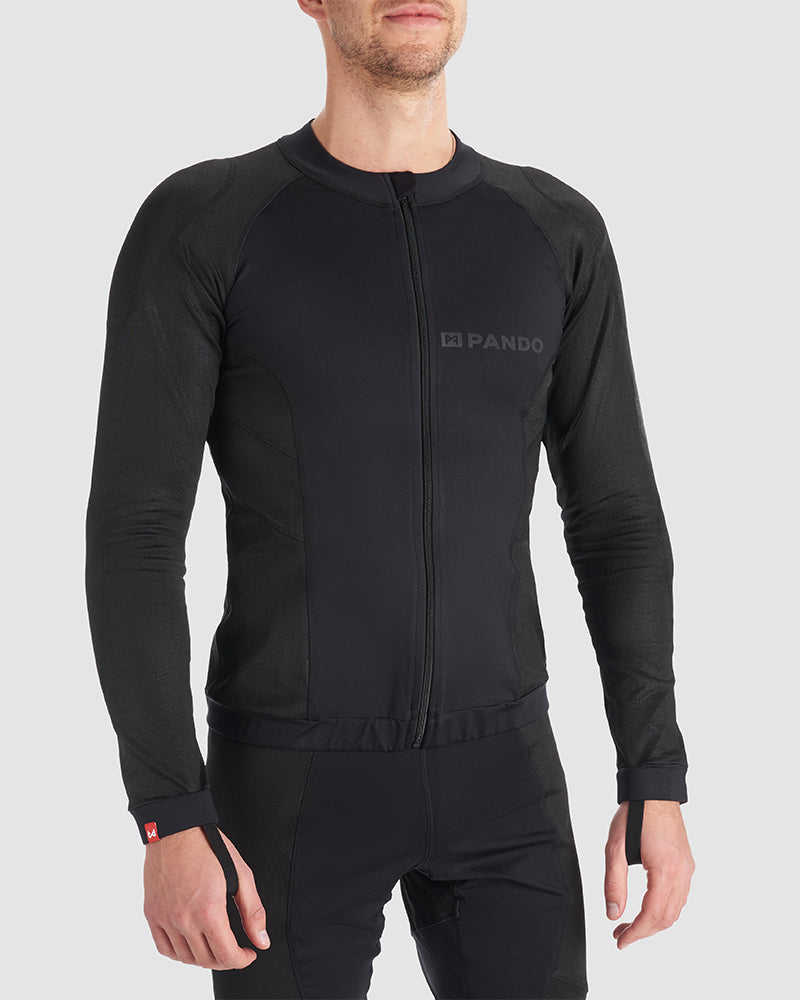
Pando Moto · UHMWPE · CE AA
Shell UH 03 Base Layer
$399 →
Cordura® + UHMWPE hybrid · Highest CE garment class
Pando Moto Mark Olive AAA Cargo Jeans
A 12oz Cordura® super-stretch denim outer plus Balistex® UHMWPE lining in the high-risk slide zones (knees, seat, outer thighs). The combination hits CE Class AAA — the highest garment-level rating under EN 17092, usually reserved for full leathers. D3O® Level 1 hip and knee armor included.

Pando Moto · Cordura + UHMWPE · CE AAA
Mark Olive AAA Cargo Jeans
$386 →
Kevlar® · The casual-wear classic
Beyond Riders Ultra Reflective Hoodie
Kevlar®-lined in the high-abrasion zones, with SAS-TEC Tripleflex Level 1 joint pads at the elbows and shoulders. The hoodie route — works for the rider who wants visible reflective styling on the daily commuter wardrobe without going to a full slide-rated jacket.

Beyond Riders · Kevlar lined · Level 1
Ultra Reflective Hoodie
$245 →
Want the chemistry, the comparison numbers, the CE garment-class breakdown, and the long-form decision tree? Keep scrolling → Or jump to common questions.
Common questions
Is UHMWPE stronger than Kevlar?
On a weight-normalized basis (specific strength), yes — UHMWPE has a higher strength-to-weight ratio than Kevlar®. That's why the standard UHMWPE marketing claim is "15× stronger than steel by weight." In raw tensile strength (force-to-break per cross-section), the two are closer than the marketing implies. The practical answer: in modern motorcycle gear tested under EN 17092 abrasion conditions, UHMWPE-faced fabrics consistently reach higher CE garment classes (AAA) than Kevlar®-only constructions. That's what matters for slide protection.
What's the difference between Kevlar® and aramid?
Aramid is the chemistry family; Kevlar® is one brand. Kevlar® is DuPont's branded para-aramid fiber. Twaron is Teijin's competing para-aramid (chemically near-identical, often interchangeable). Nomex is DuPont's meta-aramid (heat-resistant, used in firefighting and racing suits). When you see "Kevlar-lined" in motorcycle gear, the actual fiber may be Kevlar®, Twaron, or a generic para-aramid. The performance characteristics are similar across the family. Full aramid family explainer →
What's the difference between UHMWPE, Dyneema®, Spectra®, and Balistex®?
UHMWPE (ultra-high-molecular-weight polyethylene) is the chemistry; the rest are brand names for the same underlying fiber. Dyneema® is DSM/Avient's branded UHMWPE (originated in the Netherlands, the dominant brand globally). Spectra® is Honeywell's competing UHMWPE (US-made, chemically near-identical). Balistex® is Pando Moto's proprietary woven UHMWPE fabric used in their Shell UH 03 and Mark Olive AAA gear. All four perform similarly because they're the same base polymer — the differences are in fabric weave and how the fiber is treated in production.
Does UHMWPE replace Kevlar® entirely in modern gear?
No — they're often blended. Kevlar® holds up better at high temperatures (cigarette burns, hot exhaust, friction heat from extended slides). UHMWPE has a lower melting point and can soften from sustained heat. In premium gear you'll see both: Kevlar® or aramid lining for thermal/edge cases, UHMWPE for the primary abrasion surfaces. The Mark Olive AAA jeans (Quick Answer above) use this hybrid approach with a Cordura® outer.
Is Kevlar® waterproof?
No. Aramids absorb roughly 3-5% of their weight in water and lose some tensile strength when saturated. UHMWPE is effectively waterproof — the polyethylene structure doesn't bind water. For wet-weather riding, UHMWPE-faced gear has a small but real performance advantage. (Note: this is about the fiber, not the garment. Most riding jackets use a separate waterproof membrane regardless of which fiber is in the abrasion layer.)
How long does Kevlar® or UHMWPE last in a motorcycle garment?
Both degrade with UV exposure, but Kevlar® degrades roughly 5× faster than UHMWPE under sunlight. Kevlar® can lose up to 25% of its strength after two days of direct UV exposure; UHMWPE loses around 5% in the same period. In practice, most motorcycle gear isn't exposed to direct sunlight all day, but the difference matters for tank bags, gear stored on a bike outdoors, or southern-climate daily riders. Pure cotton or synthetic outer fabrics shield the aramid lining from most UV impact.
Why is UHMWPE more expensive?
UHMWPE is harder to manufacture into woven fabric. The fiber doesn't bond to dye or coating easily, and the gel-spinning production process used to make it requires specialized equipment. Kevlar® has been mass-produced since 1965 — manufacturing infrastructure is older and more competitive. Practical takeaway: a Kevlar®-lined garment at the $150-250 price point is the casual-wear segment; UHMWPE-faced gear at $300-400+ is the slide-rated tier. Both have their place.
Want the full breakdown? The sections below cover the chemistry of each fiber, a side-by-side comparison table, how each maps to CE garment ratings under EN 17092, and a decision framework for which to pick by riding style. Keep reading ↓
What Kevlar® Actually Is
Kevlar® is a para-aramid fiber, developed by chemist Stephanie Kwolek at DuPont in 1965. Aramids are aromatic polyamides — long-chain polymer molecules built around the benzene ring. In Kevlar's case, the molecular chains align with rigid, near-crystalline regularity, which gives the fiber exceptional tensile strength along its length.
In numbers most riders care about:
- Tensile strength: 5× stronger than steel on a weight-normalized basis (the canonical Kevlar® claim from DuPont).
- Heat resistance: Continues performing up to ~400°C / 750°F before degradation. Higher than UHMWPE.
- UV degradation: Loses up to 25% of strength after two days of direct sun. Kevlar® is light-yellow at the fiber level; the color shifts toward darker yellow / brown as UV breaks the polymer.
- Water absorption: ~3-5% of its weight, with some strength loss when wet.
In motorcycle gear, Kevlar® is most commonly used as a lining woven into the outer fabric in slide-vulnerable zones — knees, hips, elbows, shoulders, seat. The outer fabric (usually cotton denim or canvas) handles the abrasion under low-energy contact; the Kevlar® liner catches the impact when the outer shreds. The "Kevlar-lined motorcycle jeans" category is built around this pattern.
The aramid family also includes Twaron® (Teijin, chemically near-identical to Kevlar®) and Nomex® (DuPont, a meta-aramid optimized for heat resistance rather than tensile strength — Nomex is what firefighter suits and racing suits are made from). When motorcycle marketing copy says "aramid lining," any of these may be inside.
What UHMWPE Actually Is
UHMWPE — ultra-high-molecular-weight polyethylene — is a synthetic polymer with extremely long molecular chains, gel-spun into fiber form. Where Kevlar®'s structure is rigid and aromatic, UHMWPE's chains are flexible polyethylene segments aligned through the spinning process. The first commercial UHMWPE fiber, Dyneema®, was developed by DSM in the Netherlands in the late 1970s.
In numbers most riders care about:
- Tensile strength: Up to 15× stronger than steel on a weight-normalized basis. The highest specific strength of any commercially available fiber.
- Heat resistance: Performance drops above ~80-130°C / 175-265°F depending on the formulation. Notably lower than Kevlar®. UHMWPE can soften under sustained heat (extended slide friction, hot exhaust contact).
- UV degradation: Loses around 5% of strength after two days of direct sun — roughly 5× more UV-resistant than Kevlar®.
- Water absorption: Effectively zero. The fiber is hydrophobic.
UHMWPE comes under several brand names: Dyneema® (DSM/Avient, the original), Spectra® (Honeywell, the US-made equivalent), and Balistex® (Pando Moto's proprietary woven UHMWPE used in the Shell UH 03 and Mark Olive AAA). All four are the same underlying polymer — performance differences come from weave construction and finishing.
In motorcycle gear, UHMWPE is increasingly used as the face fabric rather than just a lining — the outer surface of the garment that directly contacts asphalt during a slide. Its abrasion resistance is what allows lightweight, flexible garments to reach CE Class AAA under EN 17092 — a rating that previously required full leather.
Head-to-head: Kevlar® vs UHMWPE
| Property | Kevlar® (Aramid) | UHMWPE | Winner for street riding |
|---|---|---|---|
| Specific strength | ~5× steel by weight | ~15× steel by weight | UHMWPE |
| Heat resistance | ~400°C / 750°F | ~80-130°C / 175-265°F | Kevlar® |
| UV resistance (2-day exposure) | Up to 25% strength loss | Around 5% strength loss | UHMWPE |
| Water absorption | 3-5% by weight | Effectively zero | UHMWPE |
| Density | ~1.44 g/cm³ | ~0.97 g/cm³ (floats) | UHMWPE (lighter) |
| Highest CE garment class achievable | Typically A or AA when lined | AAA (when used as face fabric) | UHMWPE |
| Price tier in motorcycle gear | $150-300 | $300-500+ | Kevlar® (cheaper) |
The headline: UHMWPE wins on slide protection performance metrics. Kevlar® wins on heat handling and price. Both are real protection fibers — the choice depends on what you're optimizing for.
How These Fibers Map to CE Garment Ratings
EN 17092 is the European CE standard that rates the slide / abrasion / tear / seam strength of complete motorcycle garments. It uses five classes:
- Class AAA: Race-grade. Highest abrasion + tear resistance. Full leather or UHMWPE-faced premium textiles.
- Class AA: Sport-touring, commuter, premium urban riding. UHMWPE-lined textiles or heavy waxed cotton.
- Class A: Urban / casual. Lower-speed protection. Kevlar®-lined jeans or basic textile jackets.
- Class B: Abrasion only, no impact armor required.
- Class C: Impact-protector carrier only — no garment-level abrasion certification.
The pattern across modern certified gear:
- Kevlar®-lined gear typically reaches Class A or AA. The aramid lining provides real abrasion resistance under the outer fabric, but the outer fabric (denim, cotton) limits the top-end class achievable.
- UHMWPE used as a face fabric (the outer surface contacting asphalt) routinely reaches Class AAA. This is the breakthrough — UHMWPE allows lightweight, flexible, breathable garments to match leather's slide rating.
- Hybrid constructions (Cordura® outer + UHMWPE lining in slide zones) split the difference — full-weight outer for everyday wear, UHMWPE catching the slide. The Mark Olive AAA jeans (Quick Answer above) use this pattern.
Critical context: EN 17092 rates only the garment's slide performance. It says nothing about impact protection — that's covered separately by EN 1621 (Levels 1 and 2). A fully-rated loadout has both: EN 1621 Level 2 inserts for impact at the joints, plus an EN 17092-rated garment for the slide.
Which One Should You Buy?
A practical framework, by riding style:
If you commute daily on city streets at 25-45 mph:
A Kevlar®-lined Class A or AA garment is enough. The Beyond Riders Ultra Reflective Hoodie ($245) or a Kevlar-lined motorcycle jean covers the speed range. Add Level 2 EN 1621 inserts at shoulders, elbows, and back for impact.
If you sport-tour, commute on highways, or ride above 50 mph regularly:
UHMWPE-faced gear at Class AA or AAA. A 60 mph slide transfers roughly 4× the kinetic energy of a 30 mph slide. The Shell UH 03 Armored Base Layer ($399) gives you CE AA invisibly under any jacket; the Mark Olive AAA jeans ($386) give you AAA on the lower body.
If you ride track days or off-road at speed:
Class AAA only. UHMWPE-faced premium textile or full leather. At track speeds the slide energy and friction temperatures both push the materials hard — and at track friction temperatures, the Kevlar® heat advantage starts to matter (one reason racing suits often blend both).
If you ride in rain frequently:
UHMWPE has a small advantage on wet-weather strength retention. Both fibers work wet, but UHMWPE doesn't absorb water and doesn't lose strength when saturated. For wet-climate daily riders, this is a real (if small) tiebreaker.
Get slide-rated, today
UHMWPE · CE Class AA
Shell UH 03 Base Layer
$399 →
Cordura + UHMWPE · CE Class AAA
Mark Olive AAA Jeans
$386 →
Kevlar lined · Level 1 inserts
Ultra Reflective Hoodie
$245 →
Or see the full lineup in our Best Motorcycle Body Armor 2026 buyer's guide →
Related Reading
- Aramid vs Kevlar® vs Carbon Fiber — the broader materials family, including where carbon fiber fits
- CE Level 1 vs Level 2 Armor — the impact side of the equation (this article only covers slide)
- What does EN 1621-1 mean? — the underlying limb-impact standard explained
- Best Motorcycle Body Armor 2026 — full buyer's guide with 10 picks across impact + slide