

CE Standards · Updated May 2026
EN 1621-1 is the European CE standard that certifies motorcycle limb armor — shoulders, elbows, knees, and hips. It tells you exactly how much impact force an armor insert transmits through to your body in a controlled drop test. Below: the kN numbers, what Level 1 and Level 2 actually mean, the zone codes printed on every certified protector, and the two products that cover all four limb zones.
Jump to:
Quick answer (what to buy) Common questions What EN 1621-1 actually means How the drop test works Level 1 vs Level 2 thresholds Zone codes & coverage How -1 fits with -2, -3, -4
Quick answer · skip the deep dive
EN 1621-1 covers four limb zones: shoulders, elbows, hips, knees. Two products cover all four.
Shoulders + Elbows · EN 1621-1 Level 2
Tripleflex Upper Body Set
Five SAS-TEC Tripleflex protectors, all CE Level 2 under EN 1621. The shoulder and elbow inserts (four pieces) are certified under EN 1621-1 specifically. Universal-fit — drops into any standard armor pocket. Replaces the Level 1 foam in stock jackets.
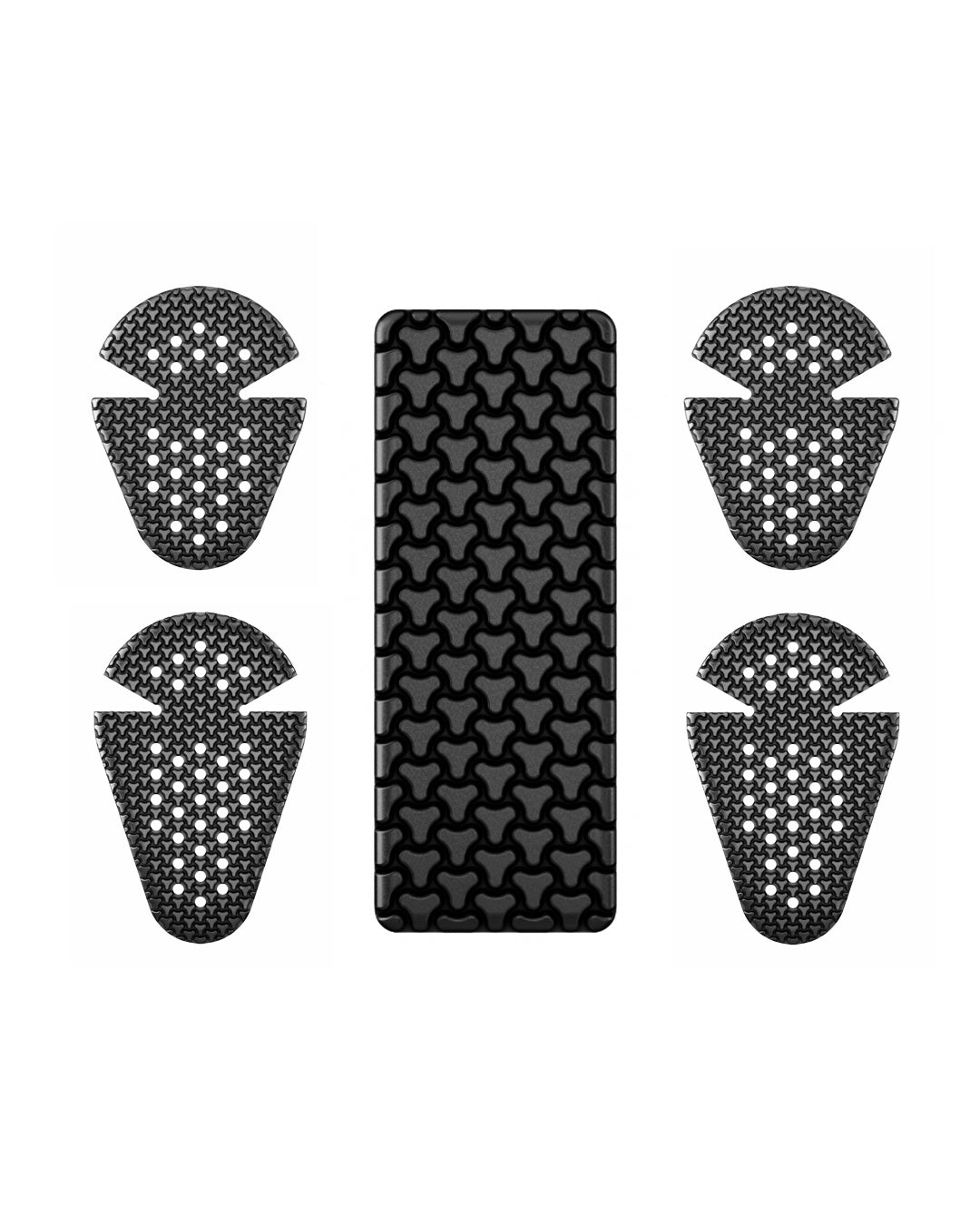
SAS-TEC · 5-Piece Set · CE Level 2
Tripleflex Upper Body Set
$94.50 $105 →
Hips + Knees · EN 1621-1 Level 1
Mark Olive AAA Cargo Jeans
D3O® Ghost™ Level 1 hip and knee armor included — both EN 1621-1 certified. The pants themselves are CE Class AAA under EN 17092 (the slide standard). Most riders armor the upper body and ride bare-legged in denim; this closes the gap on the four lower-body zones EN 1621-1 covers.

Pando Moto · D3O Ghost · CE AAA
Mark Olive AAA Cargo Jeans
$386 →
Bonus · Slide-rated + EN 1621-1 Level 1 inserts
Shell UH 03 Armored Base Layer
Comes with CE Level 1 shoulder + elbow inserts under EN 1621-1 sewn into the shirt itself. Wears invisibly under a regular jacket or hoodie. Adds CE Class AA slide protection under EN 17092 — the kind of dual-rated coverage almost no "armored hoodie" carries.
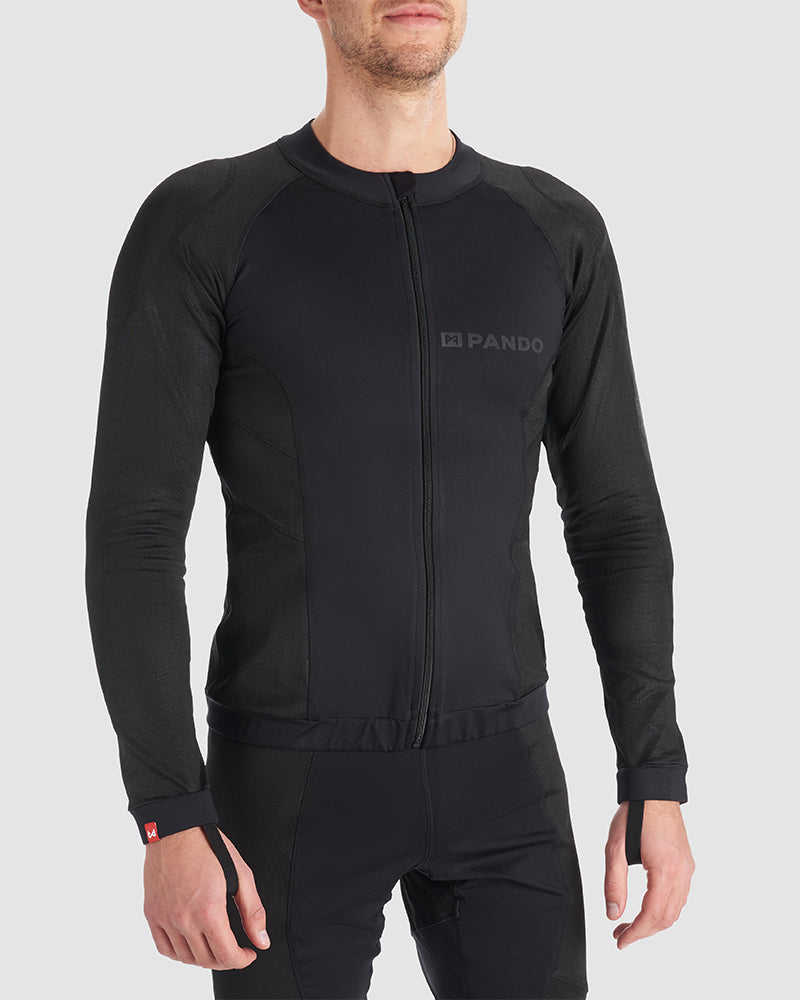
Pando Moto · UHMWPE · CE AA
Shell UH 03 Armored Base Layer
$399 →
Want the why behind each one — the actual kN numbers, the drop test methodology, the difference between Level 1 and Level 2, and how to read a CE label? Keep scrolling → Or jump to common questions.
Common questions
What does EN 1621-1 actually mean?
EN 1621-1 is the European CE standard for motorcycle limb-impact protectors — armor worn on shoulders, elbows, hips, or knees. It certifies that an armor insert, when struck in a controlled drop test, transmits force through to the wearer's body below a specified kilonewton threshold. EN 1621-2 covers back protectors, EN 1621-3 covers chest protectors, and EN 1621-4 covers inflatable airbags — same family, different body zones.
What's the difference between EN 1621-1 and EN 1621-2?
Body zone, plus the dimensions and pass thresholds of the test. EN 1621-1 covers limbs (shoulder, elbow, hip, knee). EN 1621-2 covers the back. The back-protector test uses a slightly different sample geometry to reflect the spinal area. The pass thresholds are similar in concept (Level 1 ≤ 18 kN, Level 2 ≤ 9 kN mean transmitted force in both), but the certification documents are separate — a Level 2 back protector is certified under -2, a Level 2 shoulder cap is certified under -1. For the slide side of the equation — whether the garment itself survives an asphalt slide — you want EN 17092, which is a completely separate standard. Full level explainer →
What's the difference between Level 1 and Level 2 under EN 1621-1?
Both pass the same drop test. The difference is how much impact force the protector lets through. Level 1 caps mean transmitted force at 18 kN with no single peak above 24 kN. Level 2 caps mean transmitted force at 9 kN with no single peak above 12 kN. That's roughly half the impact reaching the body. For commuting, sport-touring, and any street riding above ~25 mph, Level 2 is the realistic baseline.
What do the letter codes on my armor label mean (S, E, K, H)?
Those are the zone codes under EN 1621-1. S = shoulder, E = elbow, K = knee, H = hip. Some labels combine codes (e.g., a single insert can be shaped to fit both shoulder and elbow pockets and will carry both codes). A legitimate CE label will include four pieces of information: the standard ("EN 1621-1:2012"), the level ("Level 1" or "Level 2"), the zone code (S/E/K/H), and the coverage type (A or B — explained below).
What's the difference between Type A and Type B coverage?
Type A is reduced coverage — smaller protector, less material. Type B is normal coverage — full-size protector covering the standard anatomical area. Type B is the default for serious protection; Type A exists mostly for low-profile sport/race jackets where bulk is a constraint. Both meet the same kN thresholds within the area they cover. If the label only says "Type A," you're getting impact protection only where the smaller pad actually sits — which can mean a partial elbow strike misses the armor entirely.
How do I know if the armor in my jacket is actually EN 1621-1 certified?
Pull the insert out and read the sewn-in label. A real CE-certified protector has four pieces of information printed on it: the EN standard (e.g., "EN 1621-1:2012"), the performance level (Level 1 or Level 2), the body zone code (S/E/K/H), and the coverage type (A or B). If any of those four are missing — or if the label says "CE" without citing EN 1621 at all — the armor isn't actually certified. "CE-approved" without a specific EN-standard reference is a marketing phrase, not a certification.
Can I upgrade Level 1 inserts to Level 2 without buying a new jacket?
Almost always yes. Most armored jackets use a standardized pocket size (sometimes labeled "universal fit") that accepts aftermarket inserts in the same shape. SAS-TEC, D3O, and other manufacturers sell drop-in Level 2 replacements that fit most jacket pockets. The Tripleflex Upper Body Set (Quick Answer above) is sized for exactly this swap. See our guide to inserting Level 2 SAS-TEC armor for the step-by-step.
Want the full picture? The sections below break down the drop-test methodology, the exact kN thresholds, the zone codes printed on every certified protector, and how EN 1621-1 fits with the rest of the CE motorcycle family (back, chest, airbag, and the separate slide standard). Keep reading ↓
What "EN 1621-1" Actually Means
Decoding the label one piece at a time:
- EN — European Norm. The "CE" mark you see on certified gear is the visual indicator; the EN number is the actual standard it conforms to.
- 1621 — The standard family for motorcyclists' protective clothing against mechanical impact.
- -1 — Part 1 of the family: limb protectors (shoulder, elbow, knee, hip). Other parts cover different body zones.
- :2012 — Year the current version was published. The standard has been periodically reviewed but EN 1621-1:2012 remains the current published version as of this writing.
When you see a label that reads "EN 1621-1:2012 Level 2 E Type B", you're being told: this insert is certified under the 2012 version of the limb-impact standard, at the Level 2 performance threshold, for the elbow position, in normal (full-size) coverage. That's a fully-certified protector.
When you see a label that reads "CE-approved armor" with nothing else, you're being told: this is foam.
How the Drop Test Works
EN 1621-1 is, at its core, a single test: a controlled vertical impact on the armor insert with a precisely measured striker, recording how much force makes it through to a load cell behind the armor.
The test setup is fixed across every certified protector:
- The armor sample is placed on a steel anvil with a load cell underneath.
- A 5 kg striker is dropped onto the armor from a fixed height to deliver 50 joules of impact energy.
- The load cell records the peak force in kilonewtons (kN) transmitted to the surface below the armor — that's the force your bone would see in a crash.
- The test is repeated at five impact sites on the insert, at two temperatures (+40°C and -10°C), to confirm performance across hot and cold riding conditions.
If every single one of those impacts stays below the threshold for the claimed level, the insert passes. If any one impact exceeds the cap, it fails. There's no averaging across temperatures and no "most of the time" pass — it's pass/fail at every test point.
This matters because some marketing copy frames CE certification as a continuous performance score ("our armor scored 7.5 kN!"). It isn't. The kN value tested is whatever it is for that protector under those conditions — and once below the threshold, every insert at that level performs comparably for the test parameters. The differences below the threshold matter (sub-9 vs sub-6 protectors exist for premium back applications), but the certification is binary.
Level 1 vs Level 2: The kN Thresholds
EN 1621-1 defines two performance levels. Both pass the same test setup. The pass thresholds are what differ.
| Performance Level | Mean Transmitted Force | Single-Peak Limit | What It Means |
|---|---|---|---|
| Level 1 | ≤ 18 kN | ≤ 24 kN | Minimum acceptable. Found in commuter and entry-level gear, in many "armored" hoodies and casual riding shirts. |
| Level 2 | ≤ 9 kN | ≤ 12 kN | Roughly half the transmitted force of Level 1. The default for any serious street, sport, or touring rider. |
A 50-joule impact is roughly equivalent to a sharp body strike against an immovable object — a curb, a guard rail, a tank-bag mounting bolt — at low-to-moderate speed. Real crash impacts often exceed 50 J, but the standard is calibrated to a repeatable, reproducible test condition rather than worst-case modeling.
In practical terms: the difference between 18 kN and 9 kN of transmitted force at the elbow is the difference between a bruise that heals in a week and a fracture that ends your season. For street riders, the price step from Level 1 to Level 2 is often under $30 per limb pair. There's no real argument for Level 1 except in a few specific track-suit cases where the outer leather provides additional impact resistance.
The full impact-vs-slide picture is covered in detail in our CE Level 1 vs Level 2 armor guide.
Zone Codes & Coverage Type
Every EN 1621-1 protector is certified for a specific body zone and a specific coverage area. The label tells you both.
Body Zone Codes
| Code | Body Zone | Where you'll see it |
|---|---|---|
| S | Shoulder | Shoulder pockets in jackets and base layers |
| E | Elbow | Elbow pockets in jackets and base layers |
| K | Knee | Knee pockets in pants and over-pants |
| H | Hip | Hip pockets in pants |
Some protectors are shaped to fit multiple zones — a single Tripleflex insert, for example, can be sized for either a shoulder or elbow pocket and will carry both S and E codes on the label. That's not a marketing flag; it's a legitimate universal-fit design.
Coverage Type: A vs B
| Type | Coverage | Trade-off |
|---|---|---|
| Type A | Reduced — smaller protector | Lower profile, less bulk. Risk: partial-area strike can miss the armor entirely. |
| Type B | Normal — full-anatomical area | The default for serious protection. Covers the full pocket area in standard jackets. |
Both types meet the same kN thresholds inside their coverage area. Type A exists mostly for low-profile race suits and lightweight summer gear where bulk is a constraint. For everyday street use, Type B is the default.
How EN 1621-1 Fits with -2, -3, -4
EN 1621-1 is part of a four-part standard family. Each part certifies impact armor for a different body zone, using a similar drop-test methodology but with sample geometries and coverage shapes appropriate to the zone.
| Standard | Certifies | Zone codes |
|---|---|---|
| EN 1621-1 | Limb impact protectors | S, E, K, H |
| EN 1621-2 | Back protectors | CB (central back), FB (full back), LB (lumbar back) |
| EN 1621-3 | Chest protectors | CP (chest protector) |
| EN 1621-4 | Inflatable airbag protectors | (airbag-specific) |
Each part is certified separately. A jacket with EN 1621-1 Level 2 shoulder and elbow inserts plus an EN 1621-2 Level 2 back protector is wearing two certifications simultaneously — they're complementary, not redundant.
And — critically — none of this covers the slide side of the equation. If you crash on asphalt, the armor stops the impact at the joints. Whether the garment itself survives the slide is governed by EN 17092, a completely separate CE standard that rates the abrasion, tear, and seam strength of the fabric. A jacket can have Level 2 EN 1621-1 inserts at every limb and still shred open in less than a second on a 30 mph slide because the host garment carries no EN 17092 class. That's the marketing trap: "armored hoodie" sounds protective; what it usually means is "this hoodie has Level 1 EN 1621-1 inserts in the elbow pockets." It doesn't mean the hoodie survives asphalt.
For the materials side of slide protection — Cordura, aramid (Kevlar), UHMWPE — see our explainer on aramid vs Kevlar vs carbon fiber.
What This Means for Buying
Practical buying rules that fall out of EN 1621-1:
- Always read the label, not the marketing copy. A real EN 1621-1 protector will print the standard, level, zone, and coverage type on a sewn-in label. If any of the four is missing, the insert isn't certified.
- Default to Level 2 for shoulders and elbows. The cost step from Level 1 to Level 2 is usually under $30 per limb pair. Limb impacts are the most common in low-side crashes and the joint is the highest-leverage injury point.
- Most stock jackets ship with Level 1. Sometimes uncertified foam labeled "back pad." Pull the insert out before you ride and read the label. If it doesn't cite EN 1621-1, replace it.
- Type B unless you have a specific reason for Type A. Reduced coverage exists for race suits and ultralight gear; for street, the full-area protector covers the realistic impact area.
- Hips and knees matter as much as shoulders and elbows. Most riders armor the upper body and ride in unprotected denim. EN 1621-1 covers all four limb zones — the standard expects you to protect all four.
Build a complete EN 1621-1 loadout
Shoulders + Elbows · Level 2
Tripleflex Upper Body Set
$94.50 →
Hips + Knees · Level 1 (D3O)
Mark Olive AAA Jeans
$386 →
Or browse the full SAS-TEC armor collection →
Related Reading
- CE Level 1 vs Level 2 Armor: A Rider's Complete Guide — the level-by-level explainer for both -1 and -2 protectors
- Aramid vs Kevlar vs Carbon Fiber — the materials side of crash protection
- Kevlar vs UHMWPE for motorcycle protection — the newer fiber rising in CE AAA-rated gear
- How to insert your Level 2 SAS-TEC armor — fit guide for upgrading a stock jacket


