

Updated May 2026 · 8-min read
CE Level 1 vs Level 2 in one sentence:
Level 2 armor transmits roughly half the impact force of Level 1 in the same drop test — the European standard caps Level 1 at a mean of 18 kN, Level 2 at 9 kN. For most road riders, Level 2 is the right answer. The rest of this guide explains why, when Level 1 is fine, and where the newer sub-9 kN track-grade ratings fit in.
In this guide
Quick answer (what to buy) Common questions What CE certification means Level 1 vs Level 2 numbers Sub-9 kN track-grade Which level do I need? Zone codes & fit Impact vs slide protection
Quick answer · skip the deep dive
If you're a typical street rider, here's exactly what to look for — and what to buy.
Your spine — non-negotiable
Back protector: always Level 2
Spinal injuries are catastrophic and the price step from Level 1 to Level 2 is usually under $30. There's no scenario on the road where Level 1 back armor is the smarter choice.

SAS-TEC · Universal fit
Tripleflex Spine Protector
$43 →
Elbows · shoulders · knees · hips
Limb armor: Level 2 by default
Level 1 is fine for casual urban riding under ~45 mph. For highway, sport, ADV, or touring, Level 2 is the right answer. The 5-piece set covers back + elbows + shoulders in one purchase.
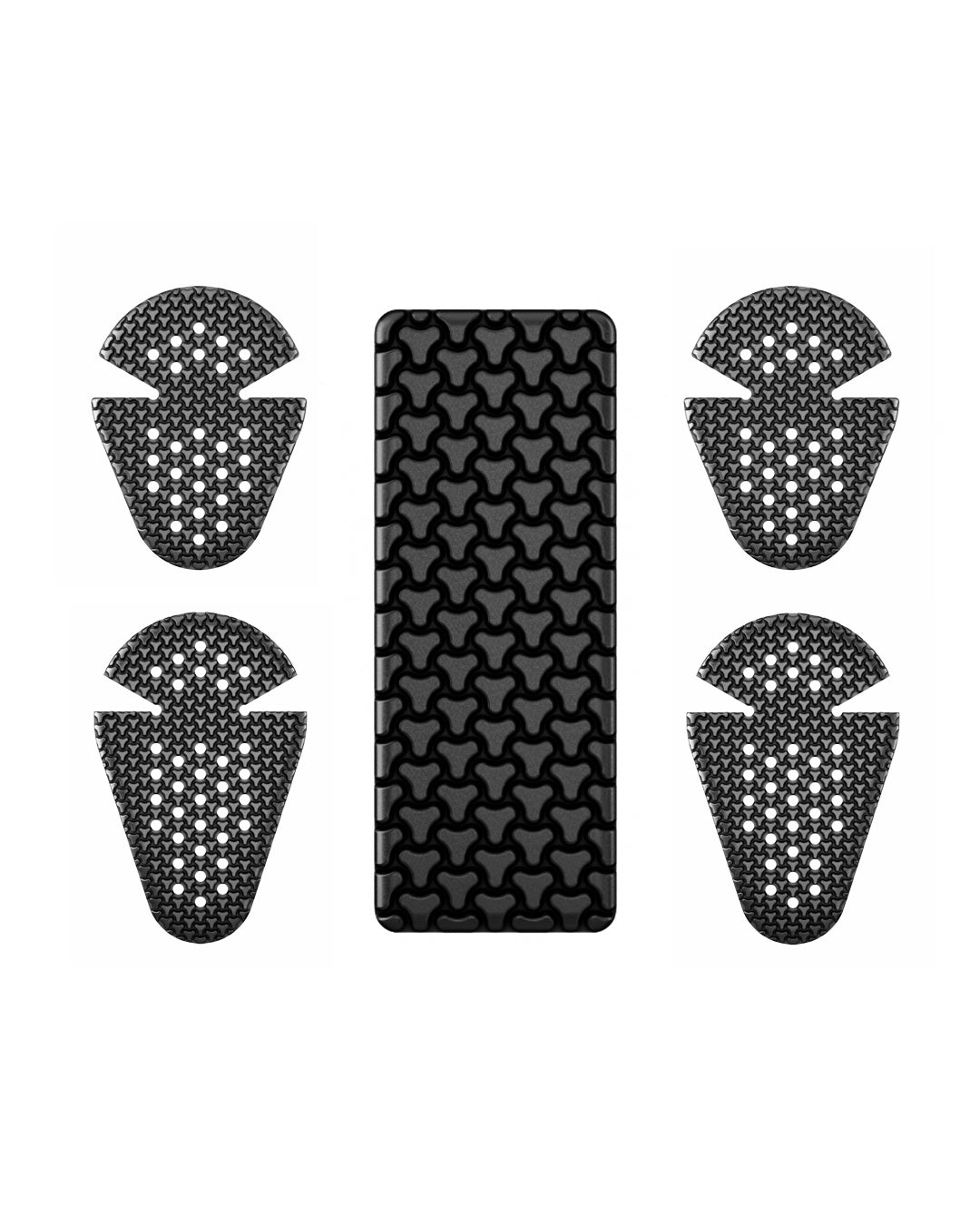
SAS-TEC · 5-Piece Set
Tripleflex Upper Body Set
$94.50 $105 →
The category most riders skip
Chest: optional, Level 2 if you ride sport, touring, or ADV
Chest armor (EN 1621-3) is its own CE category most riders don't know exists. Worth adding for highway speeds or off-road where projectiles — rocks, branches — are a real risk. $28 entry price.

SAS-TEC · Chest · EN 1621-3
Two-Piece Chest Protector
$28 →
The half of the story most marketing hides
The garment itself: look for EN 17092 AA or AAA
CE Level 1 and Level 2 only rate impact. They say nothing about whether the jacket, hoodie, or pants will survive an asphalt slide. That's a separate standard — EN 17092 — and most "armored" gear doesn't carry that rating at all. The example below has both.
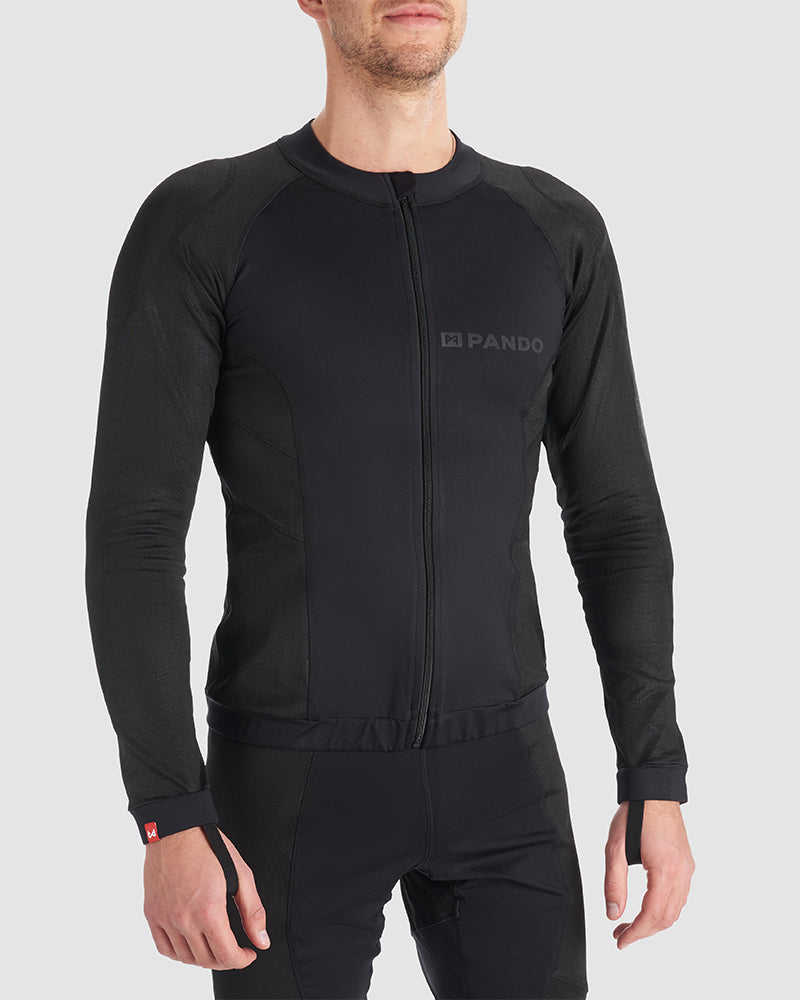
Pando Moto · Dual-rated
Shell UH 03 Armored Base Layer
$399 →
Want the why behind each of these — the kN numbers, drop tests, riding-style decision matrix, fit comparisons, and the slide-vs-impact framework? Keep scrolling → Or jump to common questions.
Common questions
Is CE Level 2 motorcycle armor worth the extra cost?
For street riding, almost always yes. Level 2 cuts transmitted impact force roughly in half versus Level 1, and the price premium is typically $10–$30 per protector. For back armor specifically, Level 2 is the only answer — spinal injuries are catastrophic and the upgrade cost is trivial.
Is Level 1 or Level 2 better?
Level 2 is better in terms of impact reduction — the standard requires it to transmit half the force of Level 1 on average (9 kN vs 18 kN). The trade-off is that Level 2 protectors are usually slightly thicker and heavier, though modern viscoelastic materials have largely closed that gap.
What does CE Level 1 mean?
CE Level 1 is the lower of the two impact-protection ratings under EN 1621. It means the armor transmits no more than 18 kN of force (mean) and 24 kN (single peak) in the standardized drop test. It's the minimum bar for being called "CE-certified motorcycle armor" — anything below isn't tested to the standard at all.
What's the difference between CE Level 1 and Level 2 back protectors?
The test method is the same (5 kg striker dropped at a controlled energy under EN 1621-2). The pass thresholds are different: Level 1 caps transmitted force at 18 kN mean / 24 kN peak; Level 2 caps it at 9 kN mean / 12 kN peak. For back protection specifically, always choose Level 2 if it fits.
Is foam padding in my jacket the same as CE armor?
No. Most generic foam padding sewn into entry-level jackets isn't tested to EN 1621 at all — meaning it has no measured impact reduction. CE-certified armor (Level 1 or Level 2) has been independently tested and labeled with the EN 1621 rating. If the inside label on your jacket doesn't mention EN 1621, the padding is probably just for shape and comfort.
Can I replace the armor in my existing jacket with Level 2?
Usually yes. Most armored jackets use a standard pocket size (sometimes called "universal fit") that accepts aftermarket inserts. SAS-TEC, D3O, and other manufacturers sell drop-in Level 2 replacements that fit most jackets. We walk through the process in our guide on inserting Level 2 SAS-TEC armor.
What's the difference between CE Level 2 and a sub-9 kN rating?
Both meet or exceed the CE Level 2 cap of 9 kN mean transmitted force. A "sub-9," "sub-6," or "sub-4" label is a manufacturer claim that the actual measured force came in below that lower number — meaning extra safety margin within the Level 2 rating. There's no Level 3 in EN 1621; sub-9 kN is the closest thing.
How do I know if my armor is real CE-certified?
Every CE-rated protector has a label sewn into it that lists the EN standard (e.g., "EN 1621-1:2012"), the level (1 or 2), the zone code (S, E, K, H, CB, or FB), and the test type (A or B). If those four things aren't on the label, the armor isn't certified — regardless of what the marketing copy says.
Want the full picture? The sections below break down each of these answers in detail — drop tests, EN 1621 family, riding-style decision matrix, fit comparisons between specific protectors, and the impact-vs-slide framework most marketing copy doesn't explain. Keep reading ↓
Most motorcycle jackets and pants ship with armor padding sewn into the elbows, shoulders, knees, and back. The padding is what catches the impact when you slide down the asphalt instead of skating across it. But not all of that padding is created equal — and a lot of it isn't even tested.
The CE marking — short for Conformité Européenne — tells you the armor in your gear has been independently tested against a European standard and either passes Level 1 or Level 2. Level 2 transmits less force to your body. Both are far better than the soft foam most riders are still wearing without realizing it.
This guide breaks down what the ratings actually mean, where the numbers come from, and how to choose — without the marketing fluff.
What CE certification actually means
The CE mark is required on Personal Protective Equipment (PPE) sold in Europe — that includes everything from hard hats to children's toys. For motorcycle armor specifically, the relevant standard is EN 1621, and it has four parts:
| Standard | What it tests | Where it goes on you |
|---|---|---|
| EN 1621-1 | Limb impact protectors | Shoulders, elbows, hips, knees |
| EN 1621-2 | Back impact protectors | Central back / spine |
| EN 1621-3 | Chest impact protectors | Sternum / front chest |
| EN 1621-4 | Inflatable (airbag) protectors | Vest- or jacket-integrated airbags |
Each part of the standard has its own pass/fail thresholds — but the basic structure is the same: a weighted impactor is dropped onto the armor at a known energy, and the force that gets through to the dummy underneath is measured. If the armor transmits less than the threshold, it passes that level.
For everyday riding gear, the two ratings you'll encounter most are EN 1621-1 on the joint pads in your jacket and pants, and EN 1621-2 on the back protector. The 2012 versions of these standards are still the dominant references on product labels in 2026 — though manufacturers are starting to migrate to the 2024 amendments, which tightened a few definitions without changing the headline Level 1 / Level 2 thresholds.
SAS-TEC Tripleflex CE Level 2 Spine Protector — an example of what an EN 1621-2 back protector looks like in practice. The honeycomb structure is what dissipates impact energy on the drop test.
Level 1 vs Level 2: the actual numbers
Both EN 1621-1 (limb) and EN 1621-2 (back) use a 5 kg striker dropped at the same energy (50 joules for limb, 50 joules for back at a fixed velocity). What changes is the cap on transmitted force — how hard you actually get hit through the armor.
| Rating | Mean transmitted force | Peak (single hit) limit | What it means |
|---|---|---|---|
| CE Level 1 | ≤ 18 kN average | ≤ 24 kN single value | Baseline protection. Adequate for casual road riding. |
| CE Level 2 | ≤ 9 kN average | ≤ 12 kN single value | Roughly half the transmitted force of Level 1. The default for serious road riders. |
In plain English: Level 2 cuts the force reaching your body roughly in half compared to Level 1 — and a Level 2 protector cuts it by closer to 70% compared to the EVA foam padding that ships in many entry-level jackets, which isn't tested to either standard.
A note on the numbers you'll see elsewhere: some older references list Level 1 as ≤ 35 kN and Level 2 as ≤ 20 kN. Those were the limits in the original 1998 version of EN 1621-1 — the standard was tightened in 2012 to the figures above, and tightened again in the 2024 amendment. If you see the older numbers on a spec sheet today, the product is probably referencing an outdated version of the test or quoting a peak value rather than a mean.

SAS-TEC Phantom Tripleflex Level 1 — Level 1 keeps the protector thinner for low-profile fit. The trade-off is roughly double the transmitted force versus Level 2, which is fine for casual road use but worth knowing.
Sub-9 kN: track-grade armor above Level 2
CE Level 2 is the ceiling of the official rating system — there is no "Level 3" in EN 1621. But for racing and track-day use, a handful of manufacturers publish their own test results that exceed Level 2 by a meaningful margin. You'll see these labeled Sub-9, Sub-6, or Sub-4, where the number is the mean transmitted force the protector achieved.
A common reference point is the Forcefield Pro Sub 4 back protector — at a measured 4 kN mean transmitted force, it passes Level 2 with more than twice the safety margin. Track-day organizers and racing federations sometimes require these higher specs above what the CE standard requires.
For street riding, sub-9 kN protectors are nice to have but not necessary — a well-fitted Level 2 protector that you'll actually wear every ride is more protection than a sub-4 protector left at home because it's bulkier.
Which level do you actually need?
For limb armor (shoulders, elbows, knees, hips), Level 2 is the default we recommend for any rider on public roads. The weight and bulk penalty over Level 1 is small with modern viscoelastic materials, and the protection margin is significant.
For back armor, the answer is even simpler: always Level 2 if you can fit it. Spinal injuries are the hardest to recover from, and the cost difference between a Level 1 and Level 2 back protector is usually under $30. There's no scenario on the road where Level 1 back is the smarter choice.
| Riding style | Limbs | Back | Chest |
|---|---|---|---|
| City commuter (under 45 mph) | Level 1 minimum, Level 2 better | Level 2 | Optional |
| Highway / sport touring | Level 2 | Level 2 | Level 1 or 2 |
| Adventure / off-road | Level 2 | Level 2 | Level 2 (rocks, branches) |
| Track / racing | Level 2 + sub-9 kN | Sub-9 kN | Sub-9 kN |
If your current jacket only has Level 1 padding or foam, swapping the inserts is usually a 10-minute job — see our guide to inserting Level 2 SAS-TEC armor for the steps.
SAS-TEC SC-1/CP7 — a two-piece chest protector certified under EN 1621-3. Most riders don't realize chest armor is its own CE-rated category, and the riding-style table above shows where it's worth adding.
Zone codes (S, E, K, H, CB) and Type A vs B
On the CE label of a protector, you'll see a letter code telling you where the armor is meant to go on the body:
| Code | Body zone |
|---|---|
| S | Shoulder |
| E | Elbow / forearm |
| K | Knee |
| H | Hip |
| CB | Central back (spine) |
| FB | Full back |
Alongside the zone code, you'll also see Type A or Type B. Type A is "reduced coverage" — smaller protectors designed for low-profile fit. Type B is "normal coverage" — larger surface area. Type B is the right answer for road use; Type A exists mainly for sport applications where mobility outweighs coverage.
Two Level 2 back protectors with very different fits
Two protectors can both carry the exact same CB · Level 2 · EN 1621-2 rating and still be the wrong (or right) shape for your jacket. The rating tells you how much force the armor transmits; it doesn't tell you whether the protector will sit flat in your back-pocket sleeve or buckle at the lumbar. Here's a concrete example using two of our top Level 2 back protectors:
SAS-TEC · Universal fit · CE Level 2
Tripleflex Spine Protector — $43
Shape: Slim rectangular slab. Designed to drop into the standard "universal fit" pocket in most armored jackets.
Medium (SC-1/B47-2): 360 × 140 × 16 mm · 225 g
Large (SC-1/B52-2): 392 × 150 × 16 mm · 260 g
Material: Viscoelastic semi-soft foam — stiffens on impact, flexes at rest.

Pando Moto · Pando fit · CE Level 2
Quatroflex Back Armor — $69
Shape: Contoured hourglass. Wider at shoulders and tailbone, narrower at the waist — drop-in fit for Pando Moto jacket back pockets.
One size: 440 × 220 × 20 mm · 250 g (fits XS–XXL Pando garments)
Material: Four-layer Nitrite + Polynorbornene rubber — multi-impact rated (no need to replace after a fall).
Which one is right for you: Measure the back-pocket sleeve in your jacket and compare to the dimensions above. If you ride a Pando Moto jacket, the Quatroflex is the engineered drop-in. If you ride almost anything else with a standard back-pocket sleeve, the Tripleflex is the universal-fit answer — pick the Medium or Large based on your torso length and the pocket depth. Both clear the same Level 2 rating; the difference is geometry, not protection.
The half of the picture EN 1621 doesn't cover
Here's the part most riders miss, and most marketing copy obscures: CE Level 1 and CE Level 2 only cover impact. They say absolutely nothing about whether the jacket, hoodie, or pants you're wearing will survive an asphalt slide.
There are two separate CE standards. They test different things. You need both.
| Standard | What it certifies | Rating scale |
|---|---|---|
|
EN 1621 -1 limb, -2 back, -3 chest, -4 airbag |
Impact absorption. How much force in kilonewtons the armor transmits through to your body when something hits it. Drop test, 5 kg striker, 50 J. | Level 1 (≤18 kN avg) or Level 2 (≤9 kN avg). Premium back protectors can also be tested to Sub-9, Sub-6, or Sub-4 for track use. |
|
EN 17092 garment-level |
Slide, abrasion, tear, and seam strength. How long the actual garment (jacket, hoodie, pants, base layer) holds together against asphalt at speed. Cambridge / AART abrasion test plus impact tear plus burst. | AAA (race-grade, highest) → AA (commuter, sport-touring) → A (urban, casual) → B (no impact armor required) → C (impact-protector carrier only). |
The trap: A product can be marketed as "armored" or "CE Level 2 armor included" and still have zero abrasion certification. The armor protects you from blunt impact at the joint or back. But if the host garment isn't rated under EN 17092, the fabric itself can shred in under a second on asphalt — and the slide finishes on bare skin.
Real-world example
A popular armored hoodie on the market sells for $154.95. The marketing copy says "armored." The product page promises an "abrasion resistant sub-panel in the elbow and shoulder area." Reading the fine print: the CE armor is sold separately, and "abrasion resistant" is the brand's own language, not a CE rating. The garment carries no EN 17092 certification at all.
Compare to a base layer like the Pando Moto Shell UH 03. Same form factor — wear-under-everything armored shirt — but it's CE-rated under both standards: Level 1 impact armor at the elbows and shoulders, AND the host garment itself is rated to EN 17092 AA. The shirt is engineered to survive the slide. The first hoodie isn't.
Both products are legitimately useful. The first one is fine for low-speed urban riding where the impact risk dominates and a slide is unlikely. The second is what you want if there's any chance you'll actually contact pavement at speed. The point isn't that one is good and one is bad — the point is that most buyers can't tell the difference because the marketing doesn't make them tell the difference.
Pando Moto Shell UH 03 — dual-rated: CE Level 1 SAS-TEC inserts at elbow and shoulder, AND a CE AA garment rating under EN 17092. The shirt itself is certified to slide.
The two questions to ask about every piece of armored gear
- What's the impact rating? Look for "CE Level 1" or "CE Level 2" under EN 1621. For back protectors, also look for Sub-9 / Sub-6 / Sub-4 markings. If the gear doesn't cite an EN 1621 level, the armor isn't independently tested.
- What's the abrasion rating? Look for "CE AAA," "CE AA," or "CE A" under EN 17092. If the gear doesn't cite an EN 17092 class, the garment isn't rated for slide protection — only the inserts inside it (if any) are rated for impact.
If a product mentions only Level 1 / Level 2, it's telling you about impact. If a product mentions only A / AA / AAA, it's telling you about slide. If a product mentions both, you've got a fully-rated piece of gear. If a product mentions neither — it's not certified at all, no matter what the marketing says.
We covered the materials side of abrasion resistance in our piece on Aramid vs Kevlar vs Carbon Fiber — that's the chemistry behind why some fabrics earn an EN 17092 rating and others don't.
Ready to upgrade?
Our top-selling CE Level 2 armor — universal fit, drop-in replacements for most jackets:
Related reading
- What does EN 1621-1:2012 mean? — the underlying impact standard explained in detail
- Aramid vs Kevlar vs Carbon Fiber — the materials that protect you from abrasion (the other half of the equation)
- Kevlar vs UHMWPE for motorcycle protection — the newer, stronger fiber rising in CE AAA-rated gear
- How to insert your Level 2 SAS-TEC armor — fit guide for upgrading a stock jacket
Originally published December 16, 2021. Updated May 12, 2026 with corrected EN 1621-1 transmitted-force figures, EN 1621 family overview, sub-9 kN ratings, and updated product references. Authored by Meghan Stark. Reviewed by Dan Wein, founder of Stealth Armor Co.


